Research Program
Assistant Professor of Strategy
Mitch Daniels School of Business · Purdue University
Editorial Boards: Strategic Management Journal · Organization Science
Journal of Organization Design

My research asks how organizational structure evolves, why it persists, and how it shapes firms’ knowledge-based activities. I treat structure as both residue and constraint: residue of earlier conditions, and constraint on later strategic action. Across acquisition histories, inventor networks, and computational models, I study when firms remain plastic, when early conditions harden into trajectories, and how internal structures shape the creation, recombination, and appropriation of knowledge.
The program works across three levels of observation. At the firm’s boundary, I examine how environmental conditions are absorbed and persist, both during periods of heightened plasticity and through firms’ ongoing interactions with external knowledge, capital, and capabilities. One level down, I examine organizational structure itself: the formal and informal arrangements that shape how knowledge moves inside the firm. At the core, I model mechanisms that archival data can usually observe only as residue: absorption, inertia, unfreezing, temporal movement, and asymmetric adjustment.
The methods follow the level of the question: archival and quasi-experimental designs at the boundary, patent-based network analysis inside the firm, and formal and computational models for mechanisms.
FIG. 1. Rings mark the level of observation: mechanisms at the core, internal structure and inventor networks in the middle, and the firm-environment interface at the boundary. Box numerals correspond to paper numbers in the CV; card navigation follows the research summary's logic by level. Click any box or circle to see its note.
Program Convergence
Structure is not just a choice variable. It is the residue of prior conditions and the constraint through which later knowledge moves.
Across acquisition trajectories, inventor networks, and computational models, the program traces a common dynamic: firms absorb conditions through structure; structure channels the creation, recombination, and appropriation of knowledge; and once set, structure changes asymmetrically.
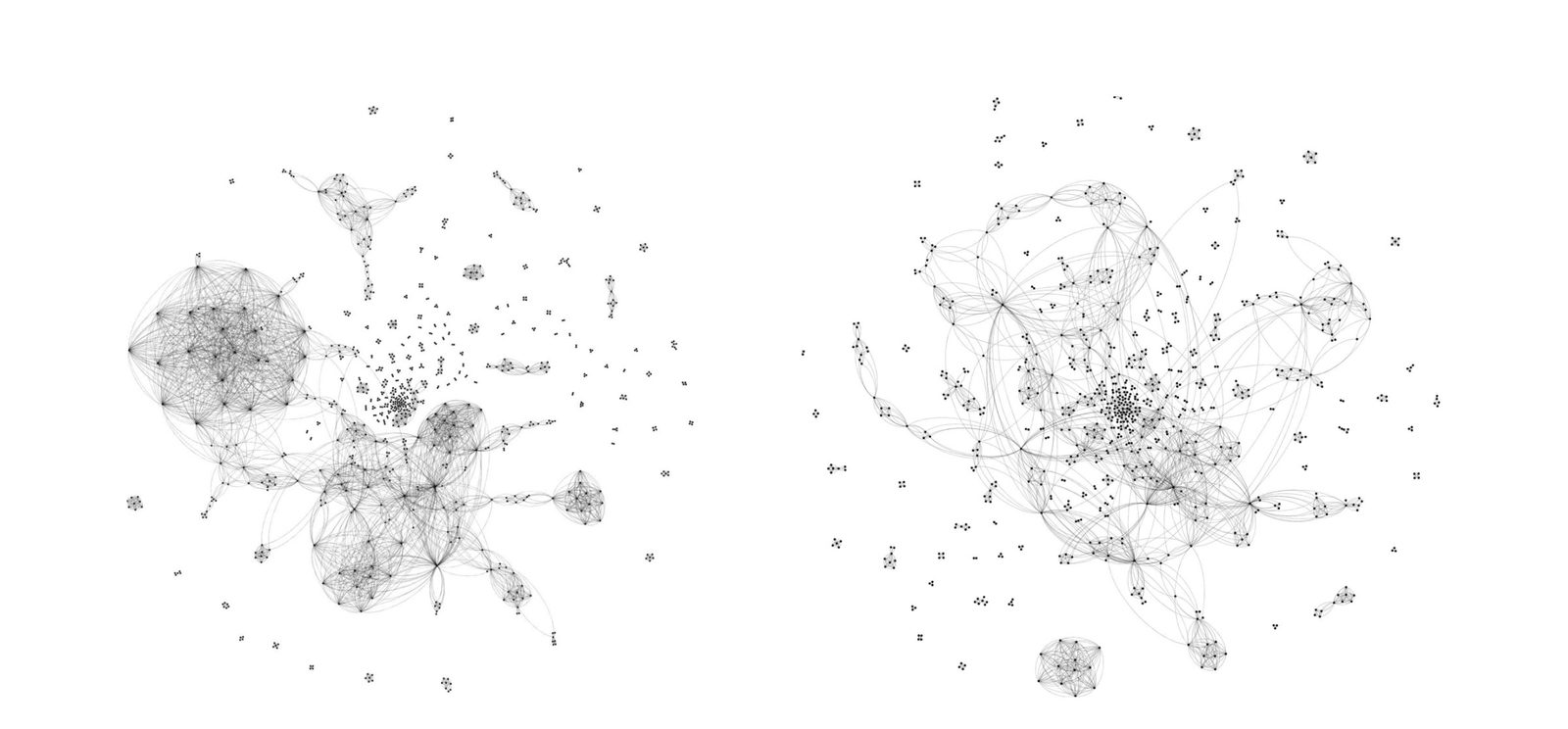
FIG. 2. Two of the intrafirm inventor networks constructed for Argyres, Rios & Silverman (2020): the same firm under different R&D authority structures. Using patent co-invention records, 7,623 of these network snapshots were constructed, one for each firm-year observation. Mathematically derived measures allowed replicable quantification of network structure across the sample and over time.
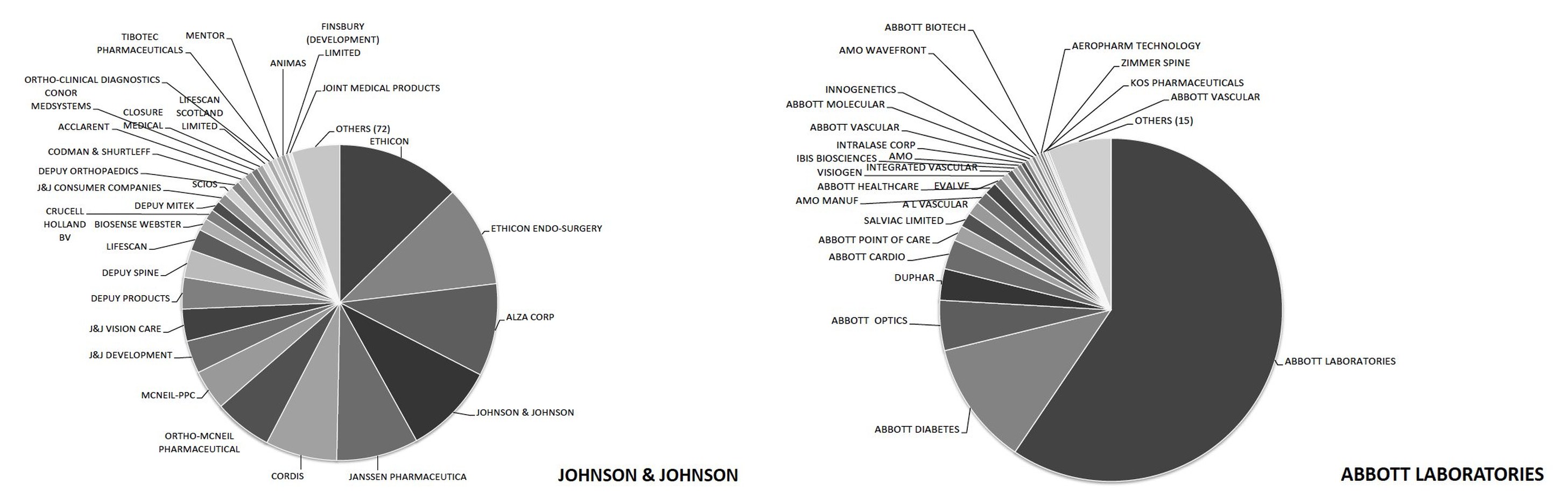
FIG. 3. Patterns of patent assignment from Arora, Belenzon & Rios (2014), top 30 affiliates shown: a decentralized pattern (Johnson & Johnson, left) and a centralized one (Abbott Laboratories, right). Our novel patent-assignment-based measure of R&D decentralization built from these data underlies the finding that decentralized units, positioned at the market boundary, derive more value from external knowledge.
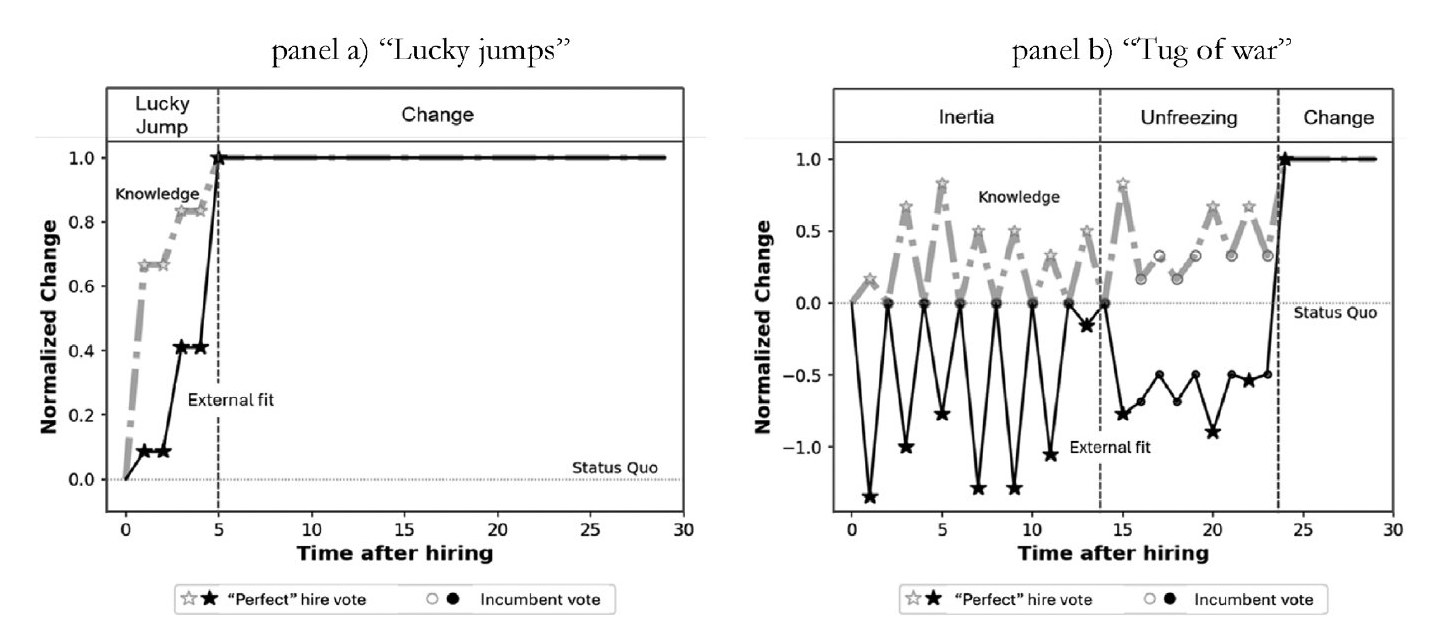
FIG. 4. Two learning histories after a 'perfect' hire, from Pham, Rios & Workiewicz (2025): 'lucky jumps' (left) and 'tug of war' (right). Star markers are changes proposed by the new hire; round markers, changes resulting from voting rounds with incumbent employees. The inertia, unfreezing, and change phases of the right panel show why the value of hiring is realized dynamically rather than at the moment of acquisition.
New Directions
Two current streams extend the program from the formation and consequences of structure to the dynamics of change and persistence. Temporal brokerage asks how knowledge moves across disconnected regions of an inventor network when no contemporaneous tie spans the gap. Organizational hysteresis asks why informal knowledge networks persist after the formal structures that produced them have changed. One stream puts time into brokerage; the other gives persistence a formal signature.
Temporal brokerage: spanning disconnected regions across time
A classic debate in innovation and network theory highlights the tradeoff between closure and brokerage. High-bandwidth, trust-based transfer thrives inside a dense group (Coleman). Yet access to non-redundant knowledge increases across structural holes (Burt). However, this tension has traditionally been argued in cross-sectional/static settings, with both sides assuming at least one path between every inventor through the network. Recent work in whole intrafirm inventor networks has shown that the second condition is generally not the case, as 40–60% of a large firm’s inventors sit in components with no collaborative path to the giant component or to one another (Argyres, Rios & Silverman 2020). In this project we resolve the tension by studying temporal brokers: inventors embedded in one region at a point in time who then are observed in another region to which there is never a co-temporal path. We argue that spanning the two sequentially rather than simultaneously allows for the ferrying of non-redundant knowledge (a la Burt), without actually bridging the separation that made it differentiated (a la Coleman).
In an analysis of 1,417 firms over 33 years, we find that patents from teams that include a recent temporal broker are more exploratory than those from teams in stable positions. This helps explain the puzzle surfaced in our earlier work (ARS2020 and ARS2025), of why isolated components are so prevalent despite on average being less exploratory than more connected parts of the network. We explore mechanism and asymmetric directionalities in movements. First-authored work with Argyres and Silverman, in preparation.
FIG. 5. A dense giant component sits between two isolated inventor components. Set connectedness to add or remove the ties between them. Three illustrative structures are shown (densely linked), one bridging tie (semi-decomposable), or no ties (Isolated). When the clusters are disconnected, two switches appear: Period advances a single inventor from one observation window (T+0) to the next (T+1), moving them across the gap, and Movement sets whether that inventor is outbound (giant → isolate) or inbound (isolate → giant). The mover counts as a temporal broker only here, where no contemporaneous tie joins the regions; the red arc is the bridge across time.
Organizational hysteresis: when networks persist beyond the structures that built them
Hysteresis describes systems whose state depends on their history, not just their current input. However, most canonical models (e.g. in magnetism and hydraulics) fully saturate and reverse. My model departs by fixing the input range so that some switching thresholds lie permanently beyond it, capturing realistic intra-firm settings in which some ties never form and some never dissolve. Read this way, formation and dissolution become path-dependent, and the bounded drive links hysteresis directly to network persistence and isolated components.
A single relay here captures the behavior of a single network tie with given thresholds of forming and dissolving. Aggregating many, each with its own threshold, blends those jumps into a smooth curve whose rising and falling paths diverge — and that divergence is the system’s memory. It is a mechanism consistent with the lagged, asymmetric network response documented in Argyres, Rios & Silverman (2020), where centralizing R&D made the inventor network more connected but decentralizing did not symmetrically unwind it. Solo work in progress building on 2017–2018 applied mathematics publications.
FIG. 6. The Preisach plane. Each dot is a hysteron: an elementary relay that switches on when the input rises past its threshold α and off when it falls below a lower threshold β. In this setting a hysteron models a single network tie — filled dots an existing tie, hollow dots a potential or dissolved one. The upper-left inset illustrates the rule for one representative tie, also shown on the plane as the red-ringed dot; its α and β shift as the population, spread, and center change.
Instructions:
Adjust input u and the red front sweeps the population: rising input flips relays from the left, falling input from the top, so which ties are active depends on the direction of travel, not just the current value of u. The Input–Output panel traces the resulting path; the dashed outline is the major loop from a full sweep. Reverse course inside it and the trace forms nested minor loops that close on their own turning points. This shows return-point memory, the formal signature of hysteretic systems. More hysterons smooth the curve; wider spread fattens the loop; raising dispersion scatters the centers outward, so the population can cross the box on both sides at once; shifting the center slides the whole population off zero, tilting the symmetric loop into a biased one. Pushed far enough, relays cross the dashed possibility box and can no longer be switched, since the input sweeps only [−1, 1]: those past α = 1 never switch on (ties that never form) and those past β = −1 never switch off (ties that never dissolve), so the loop no longer saturates.
Peer-Reviewed and Conditionally Accepted
Building on the organizational plasticity framework and data methodology developed in prior work in this program, a study of 19,984 venture-backed startups finds that early disaster exposure imprints structural fluidity that carries a trade-off: it improves market timing while raising mortality risk. LinkedIn personnel histories from a knowledge-intensive subsample show what imprinted fluidity looks like inside the firm: flatter hierarchies, greater role overlap, and broader, non-standard hiring.
Computational modeling reveals a mechanism of inertia: firms with high internal fit may face greater difficulty absorbing external knowledge because new hires disrupt tightly matched internal routines, even absent cognitive or social barriers. The value of hiring is realized dynamically rather than at the moment of acquisition.
Winner, Best Paper Award, Behavioral Strategy Interest Group, and nominee, Best Conference Paper Award, SMS Annual Conference 2025.
Drawing on patent and inventor network data, we show that specific network topologies, near-decomposability and integration may influence the speed at which firms build on their own knowledge before rivals can expropriate. We provide the first systematic large-scale documentation of Generative Appropriability, the race to recombine internal knowledge before it leaks and becomes external knowledge for rivals. A novel finding is that this process is strongly conditioned by organizational structure.
A firm's acquisitiveness is not simply a contemporaneous response to market opportunities. Using 1,201 IPO firms observed over 20 years, this paper shows that favorable conditions during a firm's early plastic period can shape persistent acquisition trajectories that remain visible across later market conditions. External sourcing is not a continuous choice but a trajectory, locked in early and persistent for decades.
Using inventor network measures developed in this line of research, formal R&D authority changes propagate through informal inventor networks over a multi-year lag. Centralization increases inventor connectedness, which in turn broadens innovation impact and technological search, showing how formal structure shapes research behavior through informal networks.
Develops a patent-assignment-based measure of R&D decentralization to show how organizational structure shapes the mode of innovation: centralized firms extract more value from internal R&D, while decentralized units, positioned at the market boundary, derive more value from external knowledge.
Using firm-level data across 15 countries, this paper shows that underdeveloped external capital markets encourage corporate group formation, linking macro-environmental conditions to firm-boundary decisions. Where external markets fall short, firms construct internal ones; a boundary condition becomes an organizational form.
Under Review and Work in Progress
Computational modeling suggests that remote work can improve outcomes in simple, stable environments but hinder organizational learning in complex, turbulent ones. These effects depend on organizational structure, implying that effective remote-work adaptation may require redesigning communication and coordination architecture, not policy adjustments alone.
Documents inventors who are sequentially embedded, deeply inside one region of the firm's network and then deeply inside another, carrying knowledge across boundaries that no single tie spans. Sequencing may unbundle the closure-brokerage tradeoff: within each region, the high-bandwidth transfer of closure; across regions, the non-redundant access of brokerage. The construct is dynamic embeddedness over time, not a static bridging position in a snapshot.
Group-based trajectory modeling across thousands of firms documents a broad tradeoff: firms following persistent transactional reconfiguration patterns exhibit higher survival rates but lower market valuations. The trajectories associated with survival differ from those associated with value creation.
In the 2020 paper, centralizing R&D increased inventor connectedness but decentralizing did not symmetrically unwind it, a directional asymmetry consistent with hysteresis. New formal modeling seeks to explain why: the components of informal ties run on different clocks. Knowing who knows what arrives in a single encounter and fades only as knowledge becomes obsolete, while trust accumulates slowly and rarely dissolves.
Compares alliances and acquisitions as alternative channels to external resources, examining the conditions under which the two modes complement one another and those under which they substitute.
Interdisciplinary & Formal Modeling Publications
Peer-reviewed work on hysteresis, threshold dynamics, and path-dependent switching. These projects reflect formal foundations for my current research on organizational persistence, adaptive constraint, and dynamic embeddedness.
Uses formal hysteresis modeling to examine how social interaction within firms can generate path-dependent organizational outcomes.
Extends hysteresis logic to economic decision-making, showing how prior states and threshold effects can make organizational and economic responses history-dependent rather than immediately reversible.
Develops a formal model of probabilistic switching in organizations, linking threshold dynamics and history-dependent response to persistent organizational behavior.
Academic Positions
Education
Editorial Service
Selected Awards & Grants